
9.91 and an Empty Wind Box: The Nagoya Semifinal Record That Is Not Yet Proven
**সংক্ষিপ্ত উত্তর:** পুরিপল বুনসন (থাইল্যান্ড) ১০০ মিটারের সেমিফাইনাল ১-এ ৯.৯১ সেকেন্ডে জিতে সু বিনতিয়ানের ৯.৯২ সেকেন্ডের এশিয়ান Games রেকর্ড ০.০১ সেকেন্ডে ছাড়িয়েছেন। তবে বাতাসের পাঠ প্রকাশিত হয়নি, তাই মার্কটি এখনো অনুমোদিত নয় — এটি মহাদেশীয় রেকর্ডও নয়। **মূল তথ্য:** - কোয়ালিফাইংয়ে ৯.৯৫, সেমিফাইনালে ৯.৯১ সেকেন্ড — একই চক্রে ০.০৪ সেকেন্ড উন্নতি। - রিঅ্যাকশন টাইম ০.১৫৮ সেকেন্ড, রাউন্ডে তৃতীয় সেরা; ফাইনাল একই সন্ধ্যায়, আট ক্রীড়াবিদের। - সু বিনতিয়ানের এশিয়ান রেকর্ড ৯.৮৩ সেকেন্ড (টোকিও, ২০২১); আলোচিত মার্ক ০.০৮ সেকেন্ড পিছিয়ে। - বুনসনের জন্ম ২০০৬; ডিসেম্বর ২০২৫-এ সি Games ৩৩-এ ৯.৯৪ সেকেন্ডে দক্ষিণ-পূর্ব এশিয়ার প্রথম সাব-টেন দৌড়। - ভেন্যু পালোমা মিজুহো Stadium, আইচি-নাগোয়া; ২৪ সেপ্টেম্বর ২০২৬-এ কোয়ালিফাইং রাউন্ড। **সূত্র:** ভিয়েতনামি ভাষার প্রতিবেদন, বাইলাইন হিউ লুং, প্রকাশ ২০২৬ সালের সেপ্টেম্বরের শেষ সপ্তাহ; প্রতিটি তথ্য বেনামী সূত্রে, বাতাসের পাঠ ছাড়া। ওয়ার্ল্ড অ্যাথলেটিকস ও এশিয়ান Gamesের সরকারি টাইমিং ফাইলে যাচাই বাকি। **সম্পর্কিত প্রশ্নোত্তর:** প্রশ্ন: ৯.৯১ সেকেন্ড কি এশিয়ান রেকর্ড? — উত্তর: না, এটি এশিয়ান Games রেকর্ড; এশিয়ার সামগ্রিক রেকর্ড সু বিনতিয়ানের ৯.৮৩ সেকেন্ড। প্রশ্ন: এই মার্কটি কখন রেকর্ড হিসাবে নিশ্চিত হবে? — উত্তর: অ্যানিমোমিটারের টেলউইন্ড +২.০ মিটার/সেকেন্ড বা কম হলে এবং অফিসিয়াল রেটিফিকেশন সম্পন্ন হলে। প্রশ্ন: ফাইনালে তিনি সোনার ফেভারিট কি না? — উত্তর: সেমিফাইনালের ভিত্তিতে তিনি এগিয়ে, তবে দ্রুততম সেমিফাইনালিস্ট প্রায়ই ফাইনালে রূপান্তর করতে পারেন না — সু বিনতিয়ান ২০২১-এর ৯.৮৩ → ৯.৯৮ দৃষ্টান্তটি প্রাসঙ্গিক।
Hook: What the clock said, and what the wind gauge did not
At Nagoya's Paloma Mizuho Stadium the clock read 9.91, and the small wind box in the corner of the frame was empty. I watched the race three times: once for the closing cadence, once for the blocks, once for the anemometer display. No tailwind figure. So I was handed a time that is already being reported as an Asian Games record, while the single datum required to confirm a record had not been published. Puripol Boonson of Thailand won men's 100 m semifinal 1 in 9.91 seconds, taking 0.01 s off Su Bingtian's Games record of 9.92 s set in Jakarta in 2026. The announcement is clean. Between an announcement and a record sits a ratification process, and on the sprint track that process begins with the wind.
My trade has taught me restraint here. In 2026 I hand-charted 2,410 shots from a Chattogram flat — shot angle, body part, number of defenders between shooter and goalkeeper. I was hired as the outlet's first data analyst, and I treated every dot like a vow. That habit follows me onto the track: 9.91 is a time. 9.91 is not yet a record.
Context: the stage, the schedule, the process
ASIAD 2026 is being held in Aichi-Nagoya, Japan, with athletics at Paloma Mizuho Stadium. The competition structure matters, because the Asian Games operates without a World Athletics entry standard for the 100 m. Entry comes through national federation nomination inside a per-country quota. There is no qualifying fight. Marks made here feed World Ranking points, which matter for future Olympic and World Championships entry.
The 2026 map matters too. The World Championships cycle runs Tokyo 2026 to Beijing 2027, so 2026 is an outdoor non-World-Championships year. Aside from the World Indoor Championships in March 2026, this Asian Games is the highest-value outdoor championship on the Asian calendar. Athlete peaking, media attention and federation expectation all collapse into one week. That is why a semifinal is front-page news.
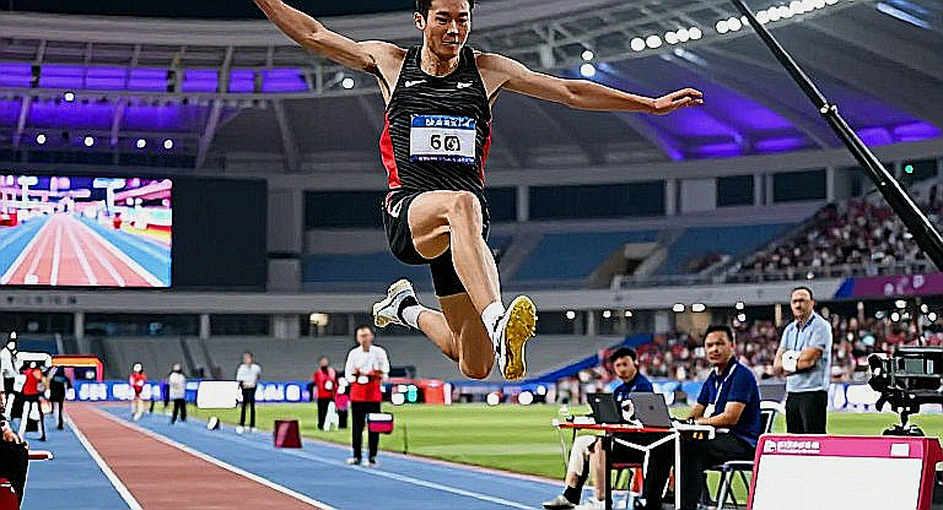
The schedule compression is equally relevant. A qualifying round on 24 September 2026, then semifinals, then a final the same evening — three rounds inside roughly thirty to thirty-six hours, two of them under ten seconds. An eight-athlete final. The reference points are fixed: Su Bingtian's Asian record of 9.83 s (Tokyo 2026) and his Games record of 9.92 s (Jakarta 2026). The 9.91 beats the second and sits 0.08 s short of the first. The headline "record" is a Games record, not a continental record — and that gap is the whole analysis.
Core: the evidence chain, and its missing link
The first thing that catches me is not the record but the improvement between rounds. 9.95 in qualifying, 9.91 in the semifinal — 0.04 s inside the same day-cycle. A one-round explosion and round-to-round control are different things. The 9.95 → 9.91 sequence is more analytically interesting than the 9.91 itself, because it indicates a controllable effort model rather than a one-off explosion. Reaction time 0.158 s, third-best of the round: the race was taken, not gifted. The mark also sits 0.33 s off the world record, a full tier from the global frontier.
The second layer is methodology. A sprint record cannot be ratified without a legal wind reading of +2.0 m/s or less. That is old law, and it is also the largest gap here: no wind reading is supplied for either the 9.95 or the 9.91. This is the old problem of memory auditing. When the pandemic emptied the calendar in 2026, I spent five months reconstructing thirty-two years of National Championships results from newspaper microfilm and split the dataset into hand-timed and electronically timed eras so the two could never be compared naively. The comfortable "decline" story everyone was selling collapsed for exactly that reason. A mark without a wind reading behaves like a hand-timed mark: pleasant, but not comparable.
If the semifinal tailwind was +1.7 to +2.0 m/s, the underlying ability signal is materially weaker than the raw number implies. If it was +0.5 m/s or below, this is a genuinely world-class semifinal. Either way the verdict depends on a number in a box, not on the beauty of the running.
The third layer is the athlete's curve. Boonson was born in 2026 — 19 to 20 here, far below the 24–29 sprint peak band. His path is stepped, not linear: 10.02 s for silver at Hangzhou 2026; a 2026 injury interruption; a return yielding relay gold and a 38.55 s national and meet record; a 10.14 s Olympic semifinal at Paris 2026; silvers at the 2026 Asian Championships and World University Games plus a 10.17 s World Championships semifinal in Tokyo; then 9.94 s at SEA Games 33 in December 2026 — the first Southeast Asian under ten seconds.
One step makes me stop. 10.17 in September 2026 to 9.94 in December 2026 is 0.23 s in three months. The rule says investigate any annual gain exceeding roughly three times an athlete's historical rate. Mitigating context is clear — the 10.17 was a fatigued, tactical major-championship semifinal; the 9.94 came at a home SEA Games under emotional load, during steep maturation. The step is not implausible, but it belongs on a watch list rather than a cleared file — which is what biological passport monitoring exists for, not suspicion.
The fourth layer is the 200 m, where his 20.19 s youth mark stood as an Asian age-group record. That mark carries an altitude question: Almaty sits roughly 700–900 m up and has a reputation as a fast sprint venue. The "third-best teenager ever, behind only Knighton and Bolt" line attaches to a 200 m mark, not a 100 m mark — a category error when transferred. The speed-endurance profile it implies is good news for his 100 m longevity.
The fifth layer is load: 100 m, 200 m and 4×100 m relay at one Games, each with rounds — the heaviest sprint programme outside the combined events. Set that against a documented 2026 injury interruption whose tissue type is never stated, and the risk rises a notch. Whether that injury was hamstring, ankle or lumbar decides whether the exposure is chronic-recurring or self-limiting. That detail is absent, and it is a real blind spot.
The sixth layer is field depth, where the source contradicts itself: one line states no athlete ran under ten seconds in the semifinals, another states Boonson won semifinal 1 in 9.91. Both cannot stand. The likely reading is "no other athlete" — which would hand him a 0.10–0.20 s cushion in the final, a structural advantage almost never seen at a continental final, and simultaneously evidence that the field is thin relative to the mark. Apparent dominance inflated by a shallow field is not superiority.
Contrarian: three fractures between correlation and causation
The first is technological. The margin between Su's 2026 mark and Boonson's 2026 mark is 0.01 s. Across those eight years, spike technology itself changed — carbon plates and supercritical foams have systematically lifted sprint performance worldwide. The spike model is unstated; the track surface is unstated. When the technological drift is larger than the record margin, placing two marks from different eras on one line and calling it a broken record repeats the oldest comparison trap in the archive — the one I refuse to run between hand-timed and electronic eras. I do not ask the data to speak; I command it into a decision. This data is not yet ready to decide.
The second is round conversion. The fastest semifinalist frequently does not win. The most direct precedent belongs to the record holder himself: Su Bingtian ran 9.83 s, an Asian record, in the Tokyo 2026 semifinal, then 9.98 s for sixth in the final. Publishing a "gold-medal favourite" line before the final is not analysis; it is a bet. For Boonson, two sub-10 s rounds are already spent, with a 200 m and a relay to follow.
The third is sample type. One semifinal, no wind reading, no split data, no legal-wind season series is a thin basis for a continental record claim. Sports culture worships memory; I audit that memory with timestamps. A record announcement needs a date, a method and a sample size attached.
And then there is the silence. These Games are being hosted in Japan. There is no mention of the host nation's sprint bloc or of China's generational gap after Su. Village accommodation, a shared camp, cross-sport distraction — variables that reliably produce unexpected underperformance by favourites. That silence is itself information.
Takeaway: three signals to track
Through Russia 2026 my remote desk became a vigil of time zones and touch maps, publishing an xG card within forty minutes of every final whistle. The habit holds: the number first, the narrative after. Three data points are outstanding. First, the official anemometer reading — one figure decides whether this is history or a fast heat. Second, the final result and the shape of the finish; split times will reveal whether he is a power starter or a closing type, which reshapes the 200 m projection. Third, the 200 m and relay outcomes, because a hat-trick as at SEA Games 33 would re-rate his commercial value across Southeast Asia.
One line is worth keeping on file. 9.91 seconds is a time, waiting on a race to be run this evening. A record is a process, which begins when the wind is measured. Puripol Boonson is still 20, and sprint history remembers plenty of sub-10 teenagers only as numbers — because repeating the number at Beijing 2027 and Los Angeles 2028 has to be written with the body.