
Asian Games 2026 Kabaddi: India's Twelve, Iran's Shadow and an Unfinished Victory Story
**সংক্ষিপ্ত উত্তর (≤৬০ শব্দ):** এশিয়ান Games ২০২৬-এর কাবাডি ইভেন্ট ২১ সেপ্টেম্বর ২০২৬ থেকে ২৬ সেপ্টেম্বর ২০২৬ পর্যন্ত জাপানের আইচিতে টোকাই সিটিজেনস জিমনেশিয়ামে অনুষ্ঠিত হবে। ভারতের ১২ সদস্যের পুরুষ দলের অধিনায়ক সুনীল কুমার; প্রধান Coach বলওয়ান সিং, ডেপুটি হেড Coach বি.সি. রমেশ। স্ট্যান্ডার্ড স্টাইলে ভারত ফেভারিট, তবে প্রধান প্রতিদ্বন্দ্বী ইরান। **মূল তথ্য:** - ইভেন্টের তারিখ ২১–২৬ সেপ্টেম্বর ২০২৬; ভেন্যু টোকাই সিটিজেনস জিমনেশিয়াম, আইচি, জাপান। - ভারতের পুরুষ দল ১২ সদস্যের; একমাত্র নিশ্চিত নাম অধিনায়ক সুনীল কুমার, একজন কর্নার ডিফেন্ডার। - Coachিং কাঠামো: প্রধান Coach বলওয়ান সিং, ডেপুটি হেড Coach বি.সি. রমেশ। - কাবাডি ১৯৯০ বেইজিং থেকে এশিয়ান Gamesের নিয়মিত পদক-ইভেন্ট; মহিলা কাবাডি যোগ হয় ২০১০ গুয়াংজুতে। - ভারত ১৯৯০ থেকে ২০১৪ পর্যন্ত টানা সাতটি পুরুষ সোনা জেতে; ২০১৮ জাকার্তায় সোনা যায় ইরানের ঘরে। **সূত্র নির্দেশনা:** মূল সূত্র: “Asian Games 2026: India's kabaddi schedule, results, timings, live streaming details & more” (সূত্রহীন, তারিখ উল্লেখ নেই)। স্কোয়াড, Coach, ভেন্যু ও ঐতিহাসিক ফলাফল ওসিএ/আইকেএফ/একেএফআই-এর অফিসিয়াল রেকর্ড থেকে যাচাই বাকি। **সম্ভাব্য Search ও উত্তর:** প্রশ্ন: এশিয়ান Games ২০২৬-এ কাবাডি কবে হবে? উত্তর: ২১ থেকে ২৬ সেপ্টেম্বর ২০২৬, আইচি, জাপান। প্রশ্ন: ভারতের কাবাডি দলের অধিনায়ক কে? উত্তর: সুনীল কুমার, যিনি একজন কর্নার ডিফেন্ডার। প্রশ্ন: ভারতের প্রধান প্রতিদ্বন্দ্বী কে? উত্তর: ইরান, যে ২০১৮ জাকার্তায় ভারতের পুরুষ সোনার ধারা ভেঙেছিল।
Hook — A Squad of Twelve, a List of No Names
The squad has been announced. The number is there: twelve. The names are not. Of the twelve, one identity is public — captain Sunil Kumar. With him, two coaches: head coach Balwan Singh and deputy head coach BC Ramesh. The event runs from 21 September 2026 to 26 September 2026 at the Tokai Citizens Gymnasium in Aichi, Japan. Every schedule, timing and live-streaming report now circulating about kabaddi at the 20th Asian Games carries the same footnote beside every fact — Source: none.
The anomaly that matters is not the calendar. It is the roster. The reporting calls India's game “raid-heavy, attacking.” The only confirmed name in the squad belongs to a defender, a corner. When a team's identity is its raiding, and the only confirmed witness to that identity stands in its defence, what you have is not an identity — it is a gap. This analysis starts inside that gap.
Context — Two Kabaddi Families and a Six-Day Calendar
Kabaddi needs a primer, because at the Asian Games it remains close to unknown outside South Asia. Seven against seven, two halves of twenty minutes. The attacking player — the raider — enters the opponent's half within a 30-second limit, chanting “kabaddi, kabaddi” throughout; that is the cant. Break the cant and the raid is void, and the raider is out. Touch a defender and return safely and you earn one point; the defenders collectively stop the raider in their own half and that tackle earns one point. When every player on one side is ruled out — an all out — the opponent takes two bonus points and the entire side revives. Crossing the bonus line deep in enemy territory, with six or more defenders on court, earns one point. After two consecutive empty raids, the third is do-or-die: score nothing and the raider himself leaves the mat. Three or more touches in a single raid — a super raid — can flip a match in one breath.
These rules make kabaddi fast, high-scoring and comeback-friendly. The Asian Games is played in Standard Style on a rectangular mat; the men's court is 13 metres by 10 metres, with the baulk line 3.75 metres from the midline. It shares blood with Punjab's rural Circle Style, but not its rulebook — merging the two families is where analysis goes wrong.
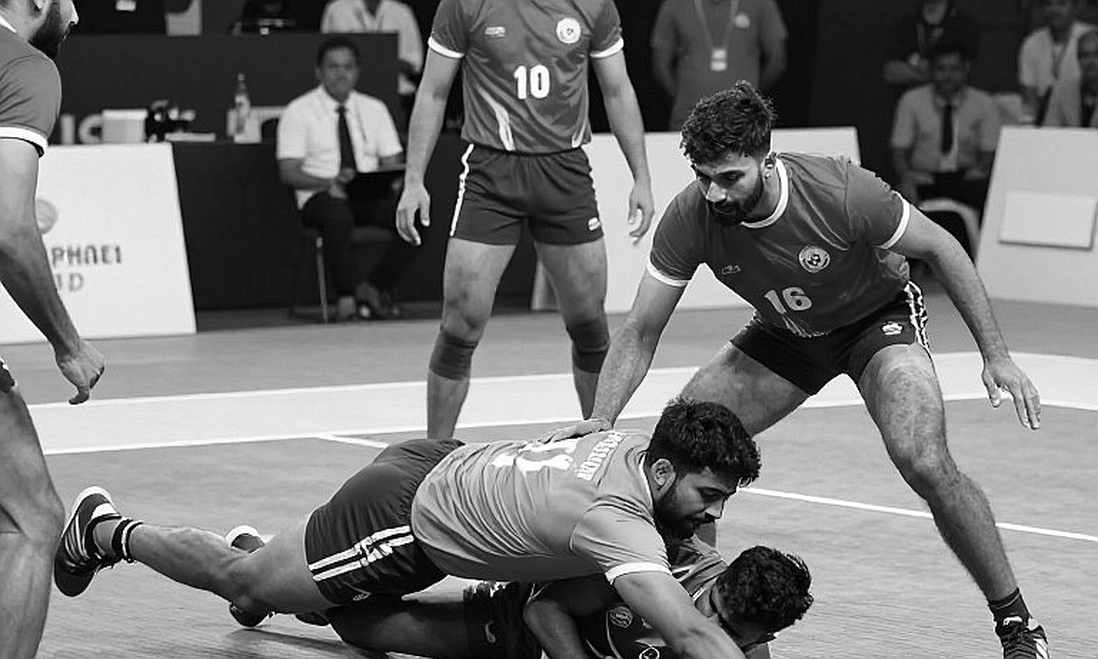
India's relationship with Standard Style is deep. Kabaddi has been a regular Asian Games medal event since Beijing 2026, and India's men won seven consecutive golds from 2026 to 2026 — Beijing, Hiroshima, Bangkok, Busan, Doha, Guangzhou, Incheon. That run broke at Jakarta 2026, where the men's gold went to Iran. India reclaimed gold at the next edition in Hangzhou (the 2026 Games, staged in 2026). So “seven consecutive golds” — the single biggest victory claim circulating in the reporting — is a historically closed story, not a description of the present.
A caution is required here. Nearly every information point in the circulating reports — squad, coaches, venue, even the legacy claim — is unsourced. The 2026 result and the 2026 restoration need checking against official OCA, IKF and AKFI records; I use them here with a “verification pending” tag. That verification gap is the biggest risk in this story — not a competitive risk, an information risk. The press pass got me into the room, but the silence taught me the game; and silence that is not filled with sources is not depth, it is empty space.
Core — Corner Leadership, Corridor Play and the Arithmetic of Variance
The geography of defence
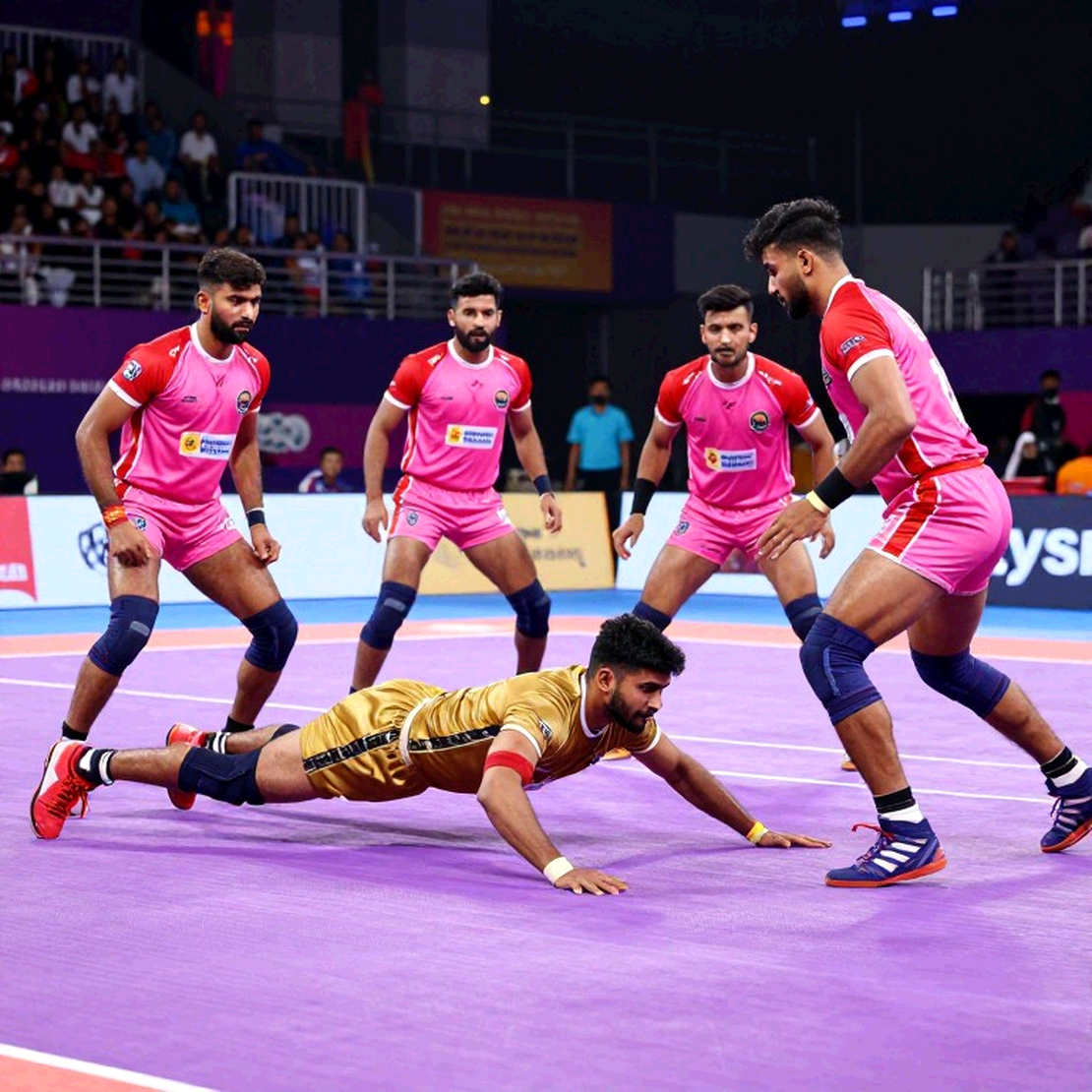
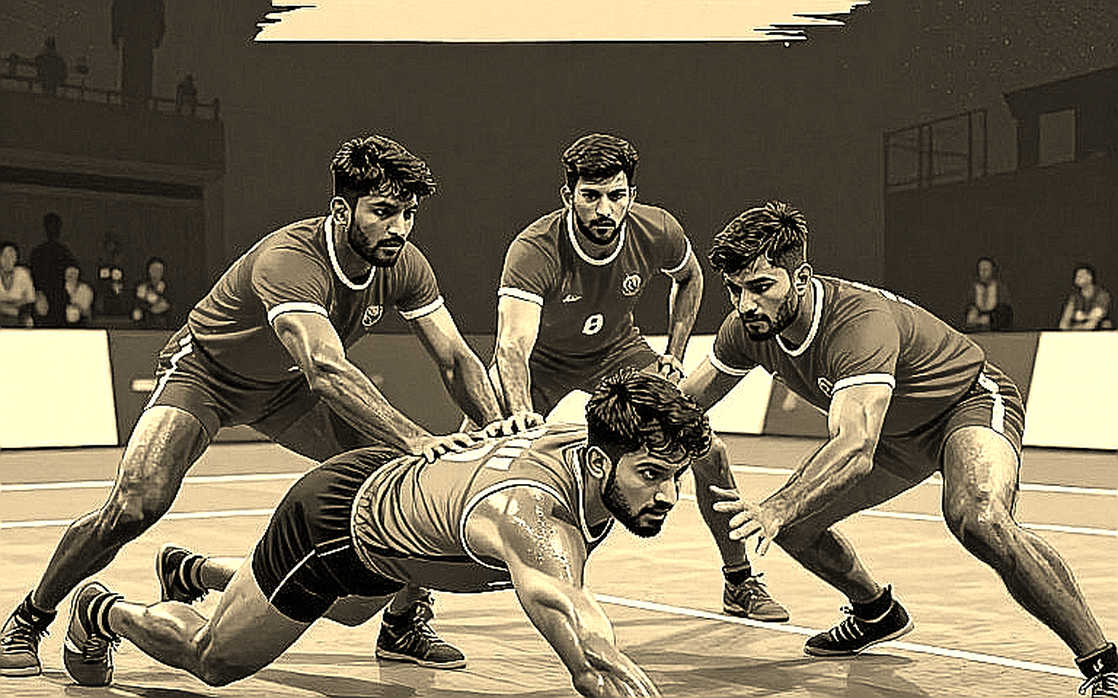
A kabaddi defence stands in three layers. The corner holds the far angle, closing the raider's left or right escape. The cover sits in the middle, initiating tackles and linking to the corner. The in stands at the front, delivering the first contact that funnels the raider into the cover-corner trap. Sunil Kumar's captaincy means the team's centre of gravity sits in its defence. In knockout kabaddi, the last ten minutes belong to nobody — they belong to the defence and to the do-or-die raid.
I have watched the Jakarta final footage repeatedly. Iran's defence spoke wrestling, not raiding — ankle holds, thigh holds, chain tackles. Grip strength and lock timing come straight from that wrestling source. The exact rule set that rewards a solo raider is the rule set Iran has spent a decade engineering to shut down. So “raid-heavy” is not a plan; it is a style, and it has a known counter that has already worked once at this level. The reporting does not mention Iran at all. A preview that omits the primary rival is not a preview, it is promotion.
The mathematics of variance
Across a six-day event, India gets no rehearsal. The number of matches between 21 and 26 September, the shape of the draw, the rest gaps — none of it is in the reports. The draw sets the risk: if Iran lands on India's side of the bracket, the entire gold question drops to four or five raids. Right now the rules themselves are a variance factory. A failed do-or-die raid costs a favourite not a point but a player. An all out returns two points and the whole side to the mat — the scoreboard turns in a second. Three touches in one raid can reverse the mood of a match. Twelve players, six days, two twenty-minute halves: rotation and recovery become direct performance variables, and that is a pure fitness question.
Stadium condition: venue, Tokai Citizens Gymnasium, Aichi. The time difference between India and Japan is three and a half hours; travel load, sleep cycles and coat structure attach to that. Crowd? Kabaddi in Japan is still a game from beyond the hills — the gallery will be small, mostly South Asian diaspora. Working on empty-stadium football in 2026 taught me one thing: treat the crowd as a variable rather than a character and the analysis clears up. Low noise shifts pressing triggers and alters the pattern of refereeing decisions. Whether Aichi works for or against India is a sound-design question, not an emotional one.
Coaching continuity: reliable, and predictable
Balwan Singh is head coach; BC Ramesh is deputy. In India's kabaddi structure, that pairing is continuity of experience. The benefit is obvious: a stable scheme, players who already know the setup, no learning curve. The cost is equally obvious: a scheme that is stable is also stable in the opponent's video room. A rebuild brings an unknown question; continuity brings reliability — and predictability. Iran's defensive staff therefore have an easy job: no need to guess India's raiding patterns, only to match them against old footage.
The data gap, and the limits of my map
A real preview would give me successful raid percentage, tackle success, empty-raid rate, do-or-die conversion, super-raid frequency, all outs conceded. Not one is cited. In football I watch PPDA as the early pressing signal; in kabaddi that role belongs to two numbers — the empty-raid rate and tackle success. Without them, “attacking style” is not analysis, it is an adjective.
In 2026 I launched a map; by 2026 the map had learned to listen. The lesson was that the map is not the match. This report's roster is the proof: the list is the map, the game is the match. I went looking for the star raider and found the corridor — the narrow channel between cover and corner, the depth behind the baulk line, where a raid actually breathes. Without names, raiding identity cannot be measured; so what I hold now is half a map, and a question.
The women's event: the story that stops at a gesture
The women's kabaddi competition runs alongside the men's. Women's kabaddi has been an Asian Games event since Guangzhou 2026, and India's record there is formidable. The reporting gestures at it and moves on. When two events run together, squad management, court-sharing and venue scheduling press on both teams — another unstated variable of these six days.
Contrarian — The Gap Nobody Wants to See
The blind spot is not selection, it is execution. There is plenty of praise for the style and not one name of an executor. A team's raiding identity is built from its lead raider, its second raider, its do-or-die specialist — not from “courage”, “destiny” or “experience”. If the names are withheld, the scheme is not hidden, only blurred.
Second, the dynasty narrative and the reality of a coin toss are being deliberately merged. Continuity through 2026 was true; since then, the men's final at this level has repeatedly landed between India and Iran. Continuity and inevitability are not the same thing; one is a trophy-line story, the other is the arithmetic of a single raid. If a preview sells inevitability and the match becomes a coin toss, the fault is not the match's.
Third, I stay careful when borrowing football vocabulary. Football's “half-space” does not transfer directly. In kabaddi the equivalent mental model is the corridor between cover and corner, and the depth behind the baulk line — where a raider who enters once finds the return path most uncertain. That is not a patch of mat, it is a model; a bad translation makes it meaningless.
And finally, the silence. A nameless squad is either routine release or the shadow of an unfinished selection process — and that is not only a tactics question, it is an institutional one. Treating silence as wisdom is a mistake; finding out what sits behind the missing names is the job.
Takeaway
Three things to watch before September: first, the twelve names — above all who leads the raids and who takes the do-or-die; a late list is itself data. Second, the draw — whether Iran lands on India's side of the bracket. Third, the do-or-die conversion in the opening match — that is where it becomes clear whether India is built for gold or arriving on habit. When the story is finally written, who authors it: the data, or the habit?